Follow Us: Facebook Page Twitter MySpace Page Flickr Page LinkedIn Group Receive Email Updates

Africa Asia Australia Canada Europe Israel Latin America United States

affiliate_link Join Free! affiliate_link


Venice, Italy

March 10th, 2010 | No Comments | Posted in Europe, Italy
Google Buzz

Things To Do on raveable

Contributed by Elina Rokhkind | Last Date of Travel: October 2009

Venice1Kosher Info: All Jewish life in Venice is clustered inside the former Ghetto area of two compact squares – Campo di Ghetto Nuovo and Campo di Ghetto Vecchio. Here you can find two meat kosher restaurants: Gam-Gam, which is owned and operated by Chabad, and Le Balthazar with the adjacent new kosher hotel Giardino del Ghetto (same ownership) under the supervision of Chief Rabbi of Venice.

It was packed in Gam-Gam on Thursday night, so reservations are recommended. The food was tasty and the service efficient, but the menu was mostly Israeli style with just a few Italian selections. On Shabbat Gam-Gam hosts communal meals (free, but donations are appreciated). They told us that in the summer they had up to 700 guests each week eating in shifts! During our October stay it was less crowded, but the restaurant was full nevertheless.

Le Balthazar also offers Shabbat meals, which you have to pre-pay. During our visit they hosted a morning Kiddush for everyone in their quaint backyard garden, so we got a glimpse of Le Balthazar’s cuisine and atmosphere. I must say, we were rather impressed, both the fresh authentic Italian delicacies they served and the lovely décor contributed to an extremely pleasant experience.

There is another small B&B in the Ghetto – Locanda del Ghetto, which only serves catered kosher breakfast for its guests.

Venice2There are also two kosher bakeries – one was never open while we were there, and the other had a nice selection of breads and pastries, and sold kosher packaged products and wine. The bakery is apparently owned by non-Jews, since it was open on Shabbat, while displaying two kashrut certificates. Chabad also runs a small makolet, where you can buy some dry goods and dairy, but it does not have set operation hours, so you need to arrange with them to open it.

Another dining option is the dairy cafeteria in the Jewish Museum of Venice, open during the museum hours. We tried it and were pleasantly surprised, as it offered simple but yummy Italian dishes and heimishe service. Finally, we discovered a gelateria Il Gelatone within a 5-minute walk outside of the Ghetto: all flavors marked with a K are kosher, but cookie holders are not permitted – ask for a paper cup.

Travel Info: Considered an ultimate romantic city with its web of narrow streets and myriads of canals, cozy squares, dreamy bridges and unique architecture, Venice would indeed be so if not for the masses of tourists. But even with the Manhattan-like crowds, the place is worth touring.

Many day-trippers never get to explore Venice beyond the St. Mark’s Square and a gondola ride. In fact, the city has a number of interesting museums and palaces one can visit, but the best part is just to roam through Venice, discover some back streets which no tourists reach, get lost in the narrow lanes and be amazed by the past grandeur and the ongoing struggle with the water to keep the history from decay. The Venetian phenomenon of acqua alta (“high waters”) caused primarily by the exceptionally high tides in the Adriatic Sea and magnified by the Venice’s continuous sinking into the lagoon, brings about periodical flooding of the area and challenges the upkeep of the suffering buildings.

Take a vaporetto (waterbus) ride along the Grand Canal – the once magnificent facades are somewhat dilapidated, but still charming. During the “high waters”, which foremost hit the overwhelmed by tourists San Marco area – the city’s lowest point, people navigate on raised platforms, and traffic can be slow.

venice3By all means, take some guided tour once in Venice to learn more about the rich and interesting history of the Venetian Republic. Both the Doge’s Palace “Secret Itineraries” tour (where they bring you to otherwise inaccessible floors of the palace) and the Clock Tower tour we took were very engaging and are highly recommended. The Doge’s Palace and the Clock Tower are both located on the famed Piazza San Marco together with the Basilica San Marco, the Campanille (bell tower) and several museums. Cafes with outside seating on the Piazza feature baroque and jazz music bands, and at night the square becomes a scene of “dueling orchestras”, when bands from different cafes take turns in showing off their virtuosity.

If you have a chance, visit other islands in the Venetian lagoon. Murano Island, famous for its glassmaking shops, is an interesting option, where you can catch a glass-blowing demo and purchase discounted (compared to Venice) glass pieces.

Jewish Info: The Ghetto area is the center of the Jewish life in Venice. Venetian Ghetto is the oldest in Europe – in 1516 it was decreed that Jews are to live in the small area in sestiere Cannaregio where the old foundries (geti in Italian) were located. Due to the guttural pronunciation of the German Jews who first settled in the geti area, the word “ghetto” appeared. Initially the Jews were given the Ghetto Nuovo, but later the Ghetto was enlarged to include Ghetto Vechio (the names of New and Old refer here to the new and old foundries, not sites of Jewish settlements). The Ghetto was closed at night, and the surrounding canals were patrolled by Christian guards. The Ghetto was abolished with the Napoleon’s conquest in 1797.
Several thousands Jews lived in this pretty confined area of two squares. Unusually high buildings with subdivided floors are the result of the cramped living conditions.

The synagogues in Ghetto Nuovo are located on the top floors of the buildings. Five beautiful 16th century synagogues (called Scole) are well-preserved and can be seen on a guided tour through the Jewish Museum of Venice. Two synagogues are open for services (the Levantine Scola in the winter, the Spanish Scola in the summer), with other synagogues functioning during the holidays.
Aside from the synagogues and the Jewish Museum, there are two Holocaust memorials, Beit-Chabad and their small yeshiva, and a bunch of Judaica stores in the Ghetto. For additional details check the Jewishitaly.org website.


Share and Enjoy:
  • Twitter
  • Facebook
  • LinkedIn
  • FriendFeed
  • Digg
  • MySpace
  • del.icio.us
  • Google Bookmarks
  • StumbleUpon
  • Technorati
  • email
  • Print
  • RSS

Check out JewishTravelTV for awesome Kosher Travel videos

---

Sponsored Links

Car Rental USA - Car rental in Florida, California, New York & other US States. Find reviews & contact details of airport car rental companies.


Tags: , , , , , , , , , , , ,
1 Star2 Stars3 Stars4 Stars5 Stars (No Ratings Yet)
Loading ... Loading ...

Cancun, Mexico

February 24th, 2010 | No Comments | Posted in Latin America / Caribbean, Mexico
Google Buzz

Things To Do on raveable

Contributed by Elina Rokhkind  |  Last Date of Travel: February 2010

Kosher Info: Your choice of eating kosher in Cancun (unless you are staying in one of the kosher resorts over Passover) is either ordering catered meals from Chabad or bringing your own food (though no beef or fresh produce allowed into Mexico), which you can supplement by a variety of kosher products found in local stores. cancun1Chabad lists what you can spot in Walmart, Sam’s Club and Costco. In addition to the familiar US hashgachos, there are two Mexican ones – KMD and VK Alef Alef  – to look out for.  For example, LALA milk (not Chalav Israel) with VK Alef Alef is easily found everywhere. On our trip to Walmart we also discovered yummy LALA yogurts and another brand with KMD hechsher (very cheap too, they were at about $0.25!), as well as cream cheese, lox, tofu, canned goods, cereals, ice cream, and lots of snacks.

Tourist Info: Cancun is a perfect sunny destination if you want to combine beach and poolside activities with sightseeing and other experiences. Cancun offers an abundance of the latter, with trips and activities sold everywhere from your hotel lobby to a mall or a street kiosk. You can choose from a variety of theme/eco-parks (Xcaret, Xplor, Xel-Ha), ancient Mayan ruins (most famous being Chichen Itza), dolphin swim programs, all-terrain vehicles jungle tours, and a number of sports and aquatic activities from zip-lining to parasailing to scuba diving, and more. If you are not an adventurous type you may choose to see the colorful marine life from the glass-bottom boat or in the aquarium. You have to travel 1-2 hours to some sites, while others are local.
cancun3
Or… you may skip all of it and simply enjoy the turquoise waters, white sand and the luxuries offered by your resort. Be aware, however, that many beach areas in Cancun are notorious for rough seas – during our weeklong visit in February the waves were pretty high and the red flag was raised most of the time.

On our visit we selected 2 day trips. One – to the beautiful island of Isla Mujeres (a 40-minute ferry ride from Cancun), where we participated in the Dolphin Encounter program at Dolphin Discovery, and later took a golf cart tour from the downtown across the island and back. Meeting and touching a dolphin was the highlight of the whole trip for our 3-year-old son.

The second trip was to the eco-park Xcaret (1.5-hour bus drive away) where you fill your day with various water activities, nature encounters, and cultural explorations, all culminating in a 2-hour-long spectacular night show, which unveils Mexican history and culture through dance and music. We also visited a small aquarium in the La Isla Shopping Village (short walk from the hotel we stayed at), which had an evening dolphin show; browsed through the pleasant La Isla mall itself, and undertook a disappointing trip to the flea market (Market 28) in the mainland Cancun. We did not explore the downtown area, but some tourists were heading there.

Cancun is composed of the city itself, where locals live, and the long strip of land (island, in fact) between the coastline and the Nichupte lagoon, called the Hotel Zone. Compared to the shiny tourist zone, the authentic Cancun was a rather unattractive sight to our taste. Buses run regularly along the Boulevard Kukulcan in the Hotel Zone and to the downtown area, making it very convenient and inexpensive to get around, while taxis are quite pricey. If you are traveling with a small child, pick him up when entering the bus – if the child walks in by himself, you pay the fare for him due to the funny automated system counting the number of feet. Also, sometimes you have to flag the bus in order for it to stop, especially in the evening. There is a number of shopping plazas and convenience stores along the Hotel Zone, where you can exchange money, and buy various necessities, as well as engage in more serious shopping. You can buy Mexican souvenirs and apparel in many places along the Hotel Zone, but you can supposedly bargain at Market 28. Beware of the timeshare sales presentations pushed everywhere – we were dragged into one right in the airport upon arrival. (To tell the truth, we were ready to sign up to one in exchange for huge sightseeing discounts, but it was surprising anyway that such presentations were offered at an airport booth, and unsuspecting visitors were somehow channeled to those booths which seemed to provide only tourist info).
cancun2
Cancun is all about luring tourists into spending more money, be it a sightseeing tour offered by your airport transfer company rep, or a sunblock sold on the tour bus, so make wise choices and don’t hold a grudge, as many locals depend on the tourist industry to make their living.

Jewish Info: When we came for the timeshare presentation, they changed our salesperson at the last moment. Perhaps, a manager saw us, who knew what a kippah on my husband’s head means. The first thing the new (very Mexican-looking) salesperson did was taking a kippah out of his pocket and confiding to us that his last name is Cohen, but they don’t let him wear kippah at work, and later producing his ID as a proof. According to him, there are lots of Jews in Cancun, which we understood to be mostly unaffiliated or traditional, and some organized Jewish community in downtown Cancun with no rabbi of their own. As nice as our salesperson was, we did not buy the timeshare.

The Orthodox community is represented by Chabad of Cancun with its enthusiastic Rabbi Mendel Druk and his lovely wife Rachel. They run a number of programs, hold services and host Shabbat at their Chabad House in downtown. Twice per month they hold Shabbat services and Kiddish dinner and lunch at Avalon Grand Hotel in the Hotel Zone. They also organize Jewish holiday celebrations and cater to various other Jewish needs both of locals and tourists. We tremendously enjoyed meeting this couple so dedicated to bringing Yidishkeit to as many Jews as possible. Please contact Rabbi Druk directly for any questions.



Share and Enjoy:
  • Twitter
  • Facebook
  • LinkedIn
  • FriendFeed
  • Digg
  • MySpace
  • del.icio.us
  • Google Bookmarks
  • StumbleUpon
  • Technorati
  • email
  • Print
  • RSS

Check out JewishTravelTV for awesome Kosher Travel videos

---

Sponsored Links

Car Rental USA - Car rental in Florida, California, New York & other US States. Find reviews & contact details of airport car rental companies.


Tags: , , , , , , , ,
1 Star2 Stars3 Stars4 Stars5 Stars (No Ratings Yet)
Loading ... Loading ...

Barcelona, Spain

February 5th, 2010 | No Comments | Posted in Europe, Spain
Google Buzz

Things To Do on raveable
Contributed by: Esther Zar | Last Date of Travel: September 2009

Kosher Info: We flew into Barcelona with a list of three potential options for kosher food. Well as we eliminated them (one didn’t answer, and the other seemed questionable in kashrut), we were left with one last option: Isamar Kosher (Address: Carrer de l’Avenir, 29). barcelona1 We didn’t know much about it, except that it’s a kosher supermarket. We decided to use our google maps to walk there and get a taste of Barcelona while we were at it. Great idea! It was easy to get to, a pleasant walk from our hotel in the city center, and ended up being a great experience. When we first walked in, we saw a small gourmet-ish kosher supermarket with particularly good meat and cheeses. We were really craving hot food, so we asked if they have a place to maybe warm up something we buy there. Next thing you know, they open up a door and we see that they have a small restaurant that they have created on the side. They had very fresh and tasty meat options that were ready to go on the grill. We chose the burgers (though the kababs looked very good as well) and the cook prepared our food with real pleasure. The few people who walked in and out were very friendly and welcoming as well. What really stuck out in my mind was that a man walked in with his children at one point and we got to talking with him. He told us that there are only 5-6 families in all of Barcelona that actually keep kosher. Very few people know about this establishment, which is truly a shame. The food is good, and if there are only a few kosher families in Barcelona, the only way for these guys to stay open is with the visits of kosher tourists. Anyway, I highly recommend this place.

barcelona2
Tourist Info: Right after we dropped off our bags at our hotel, we immediately hopped on one of those red tour buses. What a great idea. We literally got to see all the imporant sights in Barcelona, which enabled us to plan what we wanted to really see the next day. Also, the architecture in Barcelona is absolutely breathtaking, so getting to see all the different neighborhoods enables you to really get a taste of the varying types of architecture in Barcelona.

Another fun thing to do is to go through the market in the center of town. It’s extremely lively and you get a good sense for Spain’s people and smells. There’s also a beach, a beautiful stadium, and Gaudi’s park which are all interesting. But really, just wandering around through the center of town, you stumble upon the most amazing original and historic buildings.

Jewish Info: Apparently there are thousands of Jews in Barcelona, however very very few orthodox Jews. We weren’t there over Shabbat and didn’t really meet any other Jews other than that one experience in the supermarket/restaurant.
You can get more info from the Chabad (Jabad) in Barcelona here.

Sponsored Links
Find cheap flights to Europe at Flight Centre


Share and Enjoy:
  • Twitter
  • Facebook
  • LinkedIn
  • FriendFeed
  • Digg
  • MySpace
  • del.icio.us
  • Google Bookmarks
  • StumbleUpon
  • Technorati
  • email
  • Print
  • RSS

Check out JewishTravelTV for awesome Kosher Travel videos

---

Sponsored Links

Car Rental USA - Car rental in Florida, California, New York & other US States. Find reviews & contact details of airport car rental companies.


Tags: , , , , , , , ,
1 Star2 Stars3 Stars4 Stars5 Stars (No Ratings Yet)
Loading ... Loading ...

Brussels, Belgium

January 26th, 2010 | 3 Comments | Posted in Belgium, Europe
Google Buzz

Things To Do on raveable
Contributed by: Michelle Szpilzinger | Last Visited: January 2009

Kosher Info: This site has a good list of the kosher resources in Brussels. There is not much to find in the old historic center, but there are currently two kosher restaurants in the EU area, which is not a major tourist destination but is fairly simple to get to by metro. Brussels I would check to see if they are open on evenings and weekends as I know for a fact that the EU area is deserted at night. I can not vouch for them as I did not eat at either one. Unfortunately, it seems that the one kosher place in Brussels I actually visited (Pilpel) is now closed, which is a shame as it was a nice little restaurant with an adjacent kosher shop that was open in the evenings. We bought our food for Shabbos there.

For Shabbat Hospitality, contact Chabad. They offered to host us for meals and accommodation, but we opted instead to stay in the city center. They were really nice and I had good communication with them by e-mail.

If you’re staying in the city center, the kosher shops are not terribly convenient by public transportation. We opted to stay in an apartment-hotel with a kitchen rather than a regular hotel and brought a small pot and pan and some food from home so we could save money and time by making our own food. We also figured it would mean avoiding the annoying key-card issue, and we almost did — the only problem was that our flat was above a shop and when the shop was closed you had to use the key from the outside or a button on the inside to open the electric door shutter. This meant we were stuck inside Friday night (though we didn’t mind, as it was cold) and on Shabbos day had to make sure the shop was open. It was annoying but I’d still highly recommend the company, Apartments Apart, as the flat was really comfortable and nice, cheaper than most hotels, and even provided free wifi. You also get to feel more like a local for your stay.

brusselsAnother option is to head over to Antwerp where kosher food abounds. It’s only 45 minutes or so from Brussels by train, and many kosher shops and restaurants are right near the Antwerp train station.  If you’re staying in Brussels for more than a day or two, Antwerp is a must-visit whether you need the food or not.

Chocolate is, of course, a Belgian specialty; but the only brand we were told is definitely kosher is Guylian, which you can also buy internationally. We did manage to find some obscure kosher chocolate in a tiny store in Bruges that happened to have an Israeli hechsher on it, but we never saw it in Brussels.

Another Belgian specialty is beer, including many types of flavored beers. We were never given a definitive answer on the kashruth of these beers, so we stuck to regular, plain beer.

As for the ubiquitous Belgian waffles (sold in stands on nearly every street)…good luck finding kosher ones. Let me know if you do. They smelled incredible — it was torture.

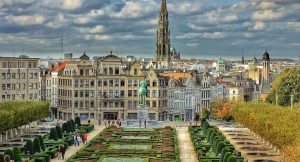
Tourist Info: Once a major medieval city, now the de facto capital of Europe, Brussels has a great mix of old and new with some amazing Art Nouveau thrown into the mix. A first stop for any visitor would be the Grand Place, a stunning square surrounded by the city hall and the glittering former guild houses of medieval merchants, where you can also find the tourist office. Every other summer the square is filled with a giant Carpet of Flowers. If I ever go to Brussels again, it’ll be a summer when I can see it. Nearby is the famous “Mannekin Pis,” a hilarious symbol of Brussels as it’s a fountain with a center sculpture of a tiny boy putting out a fire by rather unusual methods. (The title is a hint.)

Up a hill is Place Royal, home of the King’s Palace (open only in summer) and the Royal Museum of Fine Arts, which houses both the Museum of Ancient Art and a Modern Art museum.

For Elegant Shopping you can visit the Sablon Squares and Avenue Louise. If you have children with you, you might want to visit Mini-Europe.

One unique museum is the Center for Comic-Strip Art. Belgium is the home of the famous Tintin, and it’s a fun museum housed in a gorgeous Art Nouveau building. Art Nouveau lovers will also love the Museum of Musical Instruments and the Musee Horta.

Jewish Info: The Jewish community of Brussels is much smaller than the one in nearby Antwerp, much of it outside the historic center. We did not encounter a lot of it, but there are a few sites in the city center. The Great Synagogue is a lovely Neo-Romanesque structure on Rue de la Regence between the Palais de Justice and the Place Royal. There are also a couple of memorials to the Holocaust and Jewish martyrs. For more information on Jewish life in Brussels, check out the Jewish Virtual History Tour.

Share and Enjoy:
  • Twitter
  • Facebook
  • LinkedIn
  • FriendFeed
  • Digg
  • MySpace
  • del.icio.us
  • Google Bookmarks
  • StumbleUpon
  • Technorati
  • email
  • Print
  • RSS

Check out JewishTravelTV for awesome Kosher Travel videos

---

Sponsored Links

Car Rental USA - Car rental in Florida, California, New York & other US States. Find reviews & contact details of airport car rental companies.


Tags: , , , , , , , , , , , , , , ,
1 Star2 Stars3 Stars4 Stars5 Stars (No Ratings Yet)
Loading ... Loading ...

Focus on: CHINA

March 2nd, 2009 | No Comments | Posted in Asia, China
Google Buzz

China is becoming a global power in many industries, and many more kosher observant travelers and businessmen are heading over there each year.

Here are a few articles on keeping kosher in China that we felt appropriate to share on YeahThatsKosher.com:

    Keeping Kosher while Traveling in China

    WildChina.com | February 11, 2009

    Keeping kosher can always be a bit tricky, especially while traveling. But like in every developing country, awareness towards other religions and cultures is increasing (slowly, but surely). We hope you find these Kosher tid-bits useful during your Chinese travels.

    1. Kosher products are available at small western stores throughout Beijing, such as Jenny Lou’s.

    2. Kosher chickens can be bought at the German Butchery. (8610) 6591 9370 First Floor, Binduyuan Building No 15 Zaoying Beili Maizidian, Chao Yang District, Beijing.

    3. Chicken, beef, and lamb can be bought at Chabad Hashgacha. Catering and delivery of kosher meals can be arranged through Chabad for individuals (24 hours notice is required) or tour groups (two weeks notice is required. http://www.chabadbeijing.com

    4. Dini’s is the first kosher restaurant to open in Beijing. They’ll also vacuum-pack meals for you to eat on your travels around China. (8610) 6461 6220 or visit www.kosherbeijing.com

    5. Kosher Bagels under Chabad Hashgacha are available through Mrs Shanens Bagels. Ask for the Kosher Bagels and they are delivered free to your hotel/home/office (8610) 6435 9561.

    6. China is known for its wide array of fruits and vegetables! This is a chance to become familiar with all these different choices and indulge in plenty of vitamins.

FACT: Did you know China is now the world’s fastest-growing producer of kosher-certified food, with more than 500 Chinese factories producing the approved products??!!

    The Challenge of Keeping China Kosher

    The country is a fast-growing producer of kosher-certified food. But inspection and approval require a cultural balancing act — how do you explain the Book of Leviticus in an atheist nation?
    By Ching-Ching Ni, Los Angeles Times Staff Writer
    February 5, 2008

    It isn’t easy being a kosher food inspector in the land of moo shu pork. No matter how hard you try.

    “Once, they got me into a restaurant and they ordered a whole plate of food and put it in front of me,” recalls Rabbi Martin Grunberg, who has the unusual task of ensuring that Chinese factories that make food for export comply with ancient Jewish dietary laws. “They were putting me to the test because they really don’t understand why I can’t eat Chinese cuisine.”

    Keeping kosher is a breeze back home in Jerusalem, but it’s a daily challenge here in China, where food is practically a religion and people say they’ll eat anything with four legs — except for the table. It means Grunberg can’t travel light on his monthly trips through China: He carries two or three suitcases packed with dry goods, canned meats and vacuum-sealed packets, so he can feed himself breakfast, lunch and dinner. That way, he never has to step into a Chinese restaurant where about the only thing he can order is a fruit plate and can of Coke.

    Although many here have never heard the word “kosher,” China is now the world’s fastest-growing producer of kosher-certified food, with more than 500 Chinese factories producing the approved products. That number is expected to soar, not because this country that is still officially atheist has embraced Judaism, but because it’s good for business.

    “I used to get this puzzled look, ‘What is kosher?’ ” said Grunberg, 54, a field inspector for the New York-based Orthodox Union, which is responsible for certifying more than 300 plants in China. “Now a lot of people know it as a marketing tool to increase their market share, especially in the United States.”

    The largest kosher market in the world is the U.S., where a growing number of the consumers are non-Jews who see kosher-certified food as generally safer and healthier.

    That’s important in China, which is trying to recover from the recent spate of tainted-food scandals. Eager to regain consumer trust, the “Made in China” label has found an unexpected ally in the once-obscure kosher symbol.

    “People have been looking for some other measure of security for products coming out of China,” said Rabbi Shimon Freundlich, one of a handful of Beijing-based independent kosher field inspectors. “They want to see quality control, and kosher is a standard people know.”

    As China in recent years has become a factory for the world, practically anything can be made here at a bargain. The unlikely kosher business flourished simply because of supply and demand: The global appetite for kosher products exploded and China is happy to feed the frenzy.

    But even after the Chinese learned basic kosher rules — no pork, no shellfish, no fish without fins or scales — misunderstandings remain.

    As the calls poured in from Chinese companies looking for kosher approval, Freundlich recalls explaining why he couldn’t certify a toy maker that produced plastic food.

    “They sent me samples of fake apples, fake vegetables,” Freundlich said. “They were right about the food aspect. They didn’t know we don’t do wooden toys or plastic toys.”

    Then there was the guy who makes dining room tables.

    “Since food goes on the table he thought we needed a kosher table,” Freundlich said. “Of course, every table is kosher.”

    It’s even hard for many Chinese to grasp the meaning of “rabbi.”

    “Sometimes they call me ‘rabbit,’ ” Grunberg said. “I start hopping. They don’t get it. I let it pass. It doesn’t pay to explain.”

    In the frigid Chinese winter, Grunberg, a grandfather of five, keeps his white beard relatively short and covers his head with a wool hat. He keeps his yarmulke in his pocket and puts it on only when the room is warm enough. The Israeli resident has long given up on wearing his wide-brimmed black hat when traveling across China. “They get squashed,” he said, during the extended transits by plane, bus and train.

    It’s harder for Freundlich, 34, to blend in. His black beard is much longer and bushier, and some Chinese he meets can’t resist tugging at it with their fingers.

    “They used to call me Santa Claus,” said Freundlich, who moved to Beijing with his family in 2001 to start a Jewish community center. Then came the Sept. 11 attacks. “They started calling me Bin Laden, which is unfortunate.”

    But they don’t mean any harm by it, he said. For the most part, rabbis are treated with respect, even if the Chinese know very little about the Jewish people and their religion.

    “In China, we have very little contact with the Jewish people,” said Lucy Qian, the general manager at Ningbo Gooddays Food, a factory that makes mostly novelty candies here in one of China’s manufacturing hubs. “We are doing this purely because of market demand.”

    Since the factory went kosher a few years ago, sales have soared 40%, she said. Her primary customers are Israelis and Americans who want such things as kosher lipstick-shaped Barbie candy, some of which ends up on the shelves of places like Wal-Mart.

    The tainted-food scandals, she said, had no impact on her business last year. In fact, sales grew.

    “I’m sure the kosher certification helped,” Qian said.

    For now, finished products such as candy, fish and some dehydrated vegetables are a small component of the Chinese-made kosher market. The bulk of the business is in raw materials and food additives, but that is likely to change very soon, according to the Orthodox Union, which expects huge growth in the demand for kosher snacks, soft drinks and even beef.

    Jewish dietary rules originate in the Hebrew Bible, particularly the Book of Leviticus. But rabbis working in China try to sidestep serious discussions on religion to avoid political minefields in a country where anything other than state-sanctioned church activities are strictly forbidden.

    Once, Grunberg said, an official asked him during a public function to explain what religious law kosher is based on. Caught off guard, the rabbi quickly emphasized the common ground between the Chinese and Jewish people, who share long histories of pride and persecution.

    “I didn’t bring religion or God into the equation,” Grunberg said.

    That’s just fine to pragmatic Communist Party officials, who see little contradiction in describing their brand of unbridled capitalism as “socialism with Chinese characteristics.” Tolerating unfamiliar foreign ideas seems a small price to keep the export-driven economy humming.

    “The biggest benefit of going kosher is that it introduces more accountability,” said Ray Cheung, a Chinese broker who acts as a bridge between Chinese companies seeking kosher approval and Jewish agencies that certify them. “The rabbi inspectors need to know where each ingredient is made and be able to trace it back to the factory that made it. If you don’t provide that information, we don’t give you the certification.”

    Certification can be labor-intensive for the rabbis.

    During a recent trip to the Gooddays candy factory, which requires four annual inspections, Grunberg checked long lists of raw materials and poked around every warehouse and factory floor, picking up bottles of sweetener and food coloring, asking if there had been any changes in the suppliers and if the buckets on the floor were used to store anything other than kosher products.

    Sometimes, despite the best of intentions, he has to turn the applicant down.

    Once, he said, he traveled to far western China to watch Tibetan herders using a primitive method to turn yak milk into casein, a dairy protein used as a food additive.

    “It was like a million Tibetans all privately cooking this on their stoves — every home is a little factory,” Grunberg said. “It would be an impossible type of supervision.”

    Then the Chinese government stepped in to form a company that supplied the Tibetans with cows and a place to milk them by machine. Grunberg went back and certified the liquid milk that will be used for the casein.

    The rabbi’s requirements don’t always go over well with productivity-crazed Chinese plant owners.

    “Somebody once called me and asked me to come bless the fish,” said Freundlich, referring to a company that processes Alaskan fish for the American market.

    “I told him that’s not the way it works.”

    But even Freundlich wasn’t prepared for what he faced when he got to the fish plant.

    Jewish law says fish must have fins and scales to be kosher. But with frozen fish, it is difficult to tell which ones do. So even though the plant had processed thousands of fish, Freundlich says he rolled up his sleeves to check them by hand. He and a partner worked three days straight, scratching each one of the 37,000 fish with their gloved fingers.

    So many fish in the sea look the same,” said Freundlich. “If I can’t find the scale or the fin, it can’t be eaten.”

    Share and Enjoy:
    • Twitter
    • Facebook
    • LinkedIn
    • FriendFeed
    • Digg
    • MySpace
    • del.icio.us
    • Google Bookmarks
    • StumbleUpon
    • Technorati
    • email
    • Print
    • RSS

    Check out JewishTravelTV for awesome Kosher Travel videos

    ---

    Sponsored Links

    Car Rental USA - Car rental in Florida, California, New York & other US States. Find reviews & contact details of airport car rental companies.


    Tags: , , , , , , ,
    1 Star2 Stars3 Stars4 Stars5 Stars (3 votes, average: 5.00 out of 5)
    Loading ... Loading ...

New Orleans, LA

February 8th, 2009 | 4 Comments | Posted in Louisiana, USA
Google Buzz

Contributed by: Dahlia Adler Fisch | Last Date of Travel: December 2008

Jackson Square

Jackson Square

Kosher Info: New Orleans is a fantastic city for tourism; it’s fascinating, inexpensive, and has a culture unlike any other. However, walking the streets of the city as a Kosher Jew can be a challenge—New Orleans is a seriously food-centric city, and Cajun food is seriously treif. Fortunately, there is a Jewish community. Unfortunately, it’s primarily located in Metairie (MET-er-ee), a suburb of the city which cannot be reached on foot or by public transportation from the more popular destinations like the French Quarter. Metairie houses the eruv, the Orthodox Shul, and the only two kosher restaurants remaining in New Orleans after Hurricane Katrina. Cars or cabs are the only way to get to Metairie, and if you go the taxi route, be prepared to spend about $25 each way. If you do decide to travel to one of the restaurants, make it Casablanca, a delicious Moroccan restaurant with kitschy décor and a pleasant waitstaff. The other restaurant, Kosher Cajun, is certainly tasty, but less flashy and better suited for takeout than its competition. (For Shabbat meals, call Kosher Cajun by Thursday evening for Friday afternoon delivery—they’ll even take care of the grape juice and Challah.) Thankfully, both restaurants will gladly deliver to any hotel in the French Quarter for the fee of a one-way cab fare.

Since most tourists will be spending the majority of their time in the French Quarter, it’s best to be equipped

French Quarter

French Quarter

with some make-your-own-lunch staples. There are a number of Walgreens spread throughout the Quarter at which one can easily find things like peanut butter, tuna fish, and cereal; however, I strongly recommend that Kosher tourists bring their own bread, since it can be very difficult to find with a hashgacha. Truly though, the tastiest way to stave off hunger in the French Quarter is at Café Du Monde, a French Quarter landmark which sells only beignets (think Sufganiyot without the jelly), coffee, and hot chocolate, and which just became kosher in December 2008. No visit would be complete without at least one visit to this marvelous café, which is open 24/7 every day except Christmas.

Tourist Info: It’s no secret that New Orleans has gone through a lot of changes in the last few years since Hurricane Katrina. However, since the French Quarter emerged relatively unscathed, and the city has been hard at work repairing itself to its formerly glory, it’s almost impossible as a tourist to see any signs of the immense disaster unless you go looking for them. However, Katrina has had its effects in ways that are not blatantly obvious to non-natives, such as cutting the number of bus lines servicing the city in half. It’s very important that if you purchase a guide book for New Orleans, you make sure that it is no earlier than a 2009 edition, since earlier ones can easily contain important out-of-date information.

New Orleans has lots to see and most of it is blessedly inexpensive. The French Quarter provides endless entertainment both during the day, where you can busy yourself for hours looking at art on the streets, wandering into souvenir shops, walking along the Mississippi River, having your fortune told, and taking horse-and-carriage rides, and at night, when the streets are full of natives and tourists alike, singing karaoke, listening to jazz, sporting Mardi Gras beads, and drinking on the street. (The latter is mainly on the infamous Bourbon Street; for a slightly quieter view of the beautiful Quarter at night, try the tame but beautiful Dauphine Street, one block over.) Also located in the French Quarter is the Louisiana State Museum, which is actually a collection of buildings which mainly border the beautiful Jackson Square. Both the Cabildo, the historical museum in which the Louisiana Purchase was signed, and The Presbytere, which houses a fantastic and thorough exhibit on Mardi Gras, are worth their paltry six-dollar entrance fees. If museums are your thing, continue on to the New Orleans Museum of Art, which sits in the lovely City Park and includes a large sculpture garden. (The museum can be reached by riding the Canal Street Streetcar up to the last stop.)

Cable cars

Cable cars

Another New Orleans must-see is the Garden District, home to the wealthier New Orleanians an celebrities such as Archie Manning (father of Peyton and Eli) and John Goodman (who purchased his house from Nine Inch Nails frontman Trent Reznor). You can take a tour of this beautiful and historical area with a guide, or save yourself some money and follow the walking tour outlined by Frommers here. The Garden District can easily be reached by taking the St. Charles Avenue Streetcar.

Other popular tourist destinations and activities include the Audobon Zoo, Aquarium of the Americas (located by Riverside Mall and right near a bizarrely located Holocaust memorial), a steamboat cruise on the Mississippi, The National WWII Museum, going to the casino at Harrah’s, and art-gallery-hopping on Magazine Street. No matter what you choose to do, just be sure to bring your walking shoes—you’ll need ‘em.

A quick note about choosing which time of year to go: New Orleans tends to have volatile weather, but on the whole, you can expect winters to be fairly mild and pleasant, around 60 degrees. Since New Orleans is not a particularly popular destination for Christmas, hotels lower their rates around this time, and so I’d highly recommend planning your trip for the end of December, if possible. However, any time will do, except for summer, when the sweltering heat makes the southern city very unpleasant, and be wary of planning around Mardi Gras unless you’re actually looking to attend the event, since a reasonable hotel room may be nearly impossible to find.

Jewish Info: The Orthodox Jewish community of New Orleans is primarily located in Metairie, where the Orthodox Shul was forced to relocate after being damaged by Hurricane Katrina. However, there is a Chabad in the French Quarter with daily minyans as well as Shabbat services, and the website provides the names of two small hotels located within walking distance on St. Charles Avenue. The Chabad also contains a mikva, which is available by appointment only.

Share and Enjoy:
  • Twitter
  • Facebook
  • LinkedIn
  • FriendFeed
  • Digg
  • MySpace
  • del.icio.us
  • Google Bookmarks
  • StumbleUpon
  • Technorati
  • email
  • Print
  • RSS

Check out JewishTravelTV for awesome Kosher Travel videos

---

Sponsored Links

Car Rental USA - Car rental in Florida, California, New York & other US States. Find reviews & contact details of airport car rental companies.


Tags: , , , , , , , , , , , ,
1 Star2 Stars3 Stars4 Stars5 Stars (3 votes, average: 5.00 out of 5)
Loading ... Loading ...

Shanghai, China

December 4th, 2008 | 2 Comments | Posted in Asia, China
Google Buzz

Contributed by: Gavi Lewy-Neuman | October 2008

Kosher Info:

There are 2 chabad centers in Shanghai – one in Pudong, and one in the main part of Shanghai on Hong Qiao Road in the south-eastern part of town.  I haven’t visited the one in Pudong, but info can be accessed at www.jewishpudong.com.  From personal experience, I can say that the Chabad Jewish Center offers free of charge, delicious meals on Friday night and Shabbbat day. They also order kosher, Israeli products online, and you can order as well through the Chabad center.  Their website (www.chinajewish.org) advises that fruits and vegetables can be purchased locally but to wash them very carefully with disinfectant soap and water.  Buy from street vendors at your own risk.  Food and challah can be purchased from Chabad, as well.  Some of the local supermarkets do sell American products, so look for a kosher hechsher. 

Suggestion: Bring your own Traditions soup or packaged soups that just require added hot water.  A main part of the Chinese culture is soup, and on-the-go most Chinese people will have “cup-of-soup” equivalents, and to cater to that, hot water is available everywhere, even on long distance trains. This goes for everywhere in China. 

Tourist Info:

Shanghai is a terrific city with a ton to do. There are a number of historic sites and other fun places to go.

I would suggest using The Lonely Planet (either for all China, or specifically for Shanghai) to help you get around and to give a good, detailed overview of what to do. Shanghai’s the chosen location for the upcoming 2010 World Expo, and so the city is doing its best to prepare for being impressive and giving a good experience to all its visitors. I enjoyed The 88th floor Observatory at the Jin Mao tower in Pudong area for an amazing view of the whole city.  There is a lot of pollution though, so visibility quality may vary…. it is still an amazing experience, as the tower was the tallest building in China until 2007. The elevator is ridiculously fast, getting you up to the observatory (where you get a complimentary pearl, which they try and coax you into turning into a not complimentary necklace, or set of earrings) in under 45 seconds.

The BUND is quite historic, and definitely worth a visit.  It is the area next to the Huangpu River on the main side – there are lots of buildings with beautiful architectural designs.  The Lonely Planet walking tour is suggested as it gives info on what you are seeing and where is worth your time.  There is lots of construction in the area though, which does take away from the overall experience.

Renmin Square, or People’s Square is a great place to visit, and lots to see in the area.  I would recommend visiting the Shanghai Art Museum, which has amazing modern art and interesting exhibits.  The Jade Buddha Temple is certainly worth a visit, and the acrobatics show is a no-miss.  I would also recommend stopping by and seeing a show at the Shanghai Grande Central Theater. It is a small venue, so even the cheapest seats give you a great view of the incredible program. 

Jewish info:

Both Chabad Centers are great Jewish outlets. In the Hong Qiao area, they have minyanim on Shabbat, and I believe during the week as well.  The Rabbi and Rebbetzin are very welcoming.  On Friday night dinner, all the new and visiting people are required to get up and introduce themselves to everyone.  There are mainly French-speaking people there (although not the Chabad family).  In the Pudong area, there are some old, not-in-use synagogues that are now tourist attractions, and have lots of history to them. 

Share and Enjoy:
  • Twitter
  • Facebook
  • LinkedIn
  • FriendFeed
  • Digg
  • MySpace
  • del.icio.us
  • Google Bookmarks
  • StumbleUpon
  • Technorati
  • email
  • Print
  • RSS

Check out JewishTravelTV for awesome Kosher Travel videos

---

Sponsored Links

Car Rental USA - Car rental in Florida, California, New York & other US States. Find reviews & contact details of airport car rental companies.


Tags: , , , , ,
1 Star2 Stars3 Stars4 Stars5 Stars (2 votes, average: 5.00 out of 5)
Loading ... Loading ...

Dharamsala, India

December 2nd, 2008 | No Comments | Posted in Asia, India
Google Buzz

Contributed By: Avi Narrow-Tilonsky | Last Date of Travel: August 2007

Kosher Info: In Dharamkot, right outside Dharamsala, the Chabad center attracted about 200 people for Kabbalat Shabbat and Friday night dinner. Very few people speak English if that is a concern for you. The Beit Chabad in Dharamkot also runs a restaurant which serves a terrific shnitzel sandwich. You can eat your sandwich while sitting on colorful pillows on the floor, watching the mist sift through the Himalayan mountains, and exchanging travel tales with new friends. The meals on Shabbat are free but sometimes you have to share a cup with the person sitting next to you, so don’t be afraid of germs. In Dharamkot, there is also a Breslov couple that hosts visitors on Shabbat, but I did not visit them.

Tourist Info: Dharamsala is a non-urban region of northern India near Tibet, Kashmir, and the Himalayan Mts.

The main tourist area of Dharamsala is Mcleod Ganj where the exiled Tibetans are headquartered.  Most Israelis stay in the next town over, Dharamkot.  Along the main road, there are many stalls selling handmade Tibetan crafts and jewelery.  Also, it is worth spending a few extra rupees to get a room with a view of the mountains in a guest house (not many hotels).  The museum of the Tibetan Exile is a must see and on rare occasions the Dallai Llama delivers public lectures.

Jewish Info: The Chabad house has Shabbat programming and lectures and events during the week.  Additionally, Chabad runs a short term yeshiva program a few times per year.  It is mostly attended by Israelis that take some time out of their travels to study chassidut.

In Dharamsalla there are many Buddist sites, including the Dallai Llama’s temple, which might be religiously problematic.  Think it through before visiting.

Share and Enjoy:
  • Twitter
  • Facebook
  • LinkedIn
  • FriendFeed
  • Digg
  • MySpace
  • del.icio.us
  • Google Bookmarks
  • StumbleUpon
  • Technorati
  • email
  • Print
  • RSS

Check out JewishTravelTV for awesome Kosher Travel videos

---

Sponsored Links

Car Rental USA - Car rental in Florida, California, New York & other US States. Find reviews & contact details of airport car rental companies.


Tags: , , , , , , , , , , , , ,
1 Star2 Stars3 Stars4 Stars5 Stars (1 votes, average: 5.00 out of 5)
Loading ... Loading ...
Facebook Page Twitter MySpace Page Flickr Page LinkedIn Group Receive Email Updates

Africa Asia Australia Canada Europe Israel Latin America United States