



































For the first time in more than half a century, kosher food is once again being prepared in Damascus. Alongside this development, a historic synagogue has reopened for prayer, and a luxury hotel is openly accommodating Jewish visitors. Together, these changes raise an important question: what does this actually mean for Jewish travel to Syria today?
The answer is layered. These developments are historically significant and emotionally powerful, especially for Syrian Jews in the diaspora. At the same time, they do not signal that Syria is now a safe or practical destination for Jewish tourism. What follows is a factual breakdown of what has changed, what has not, and how Jewish travelers should understand this moment.
A Kosher Restaurant Exists, But With Limits
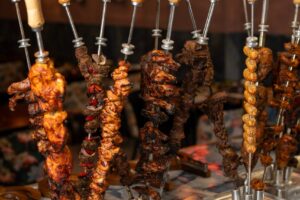
Damascus now has an operational kosher kitchen* inside the Royal Semiramis Hotel. This is the first time since the mid-20th century that kosher food has been prepared in the Syrian capital.
*The kitchen currently operates as unofficially kosher and does not yet carry formal kosher certification, though efforts are underway to pursue official certification in the near future.
The kitchen was established after Jewish visitors arrived and were unable to eat the hotel’s standard offerings. In response, hotel management created a completely separate kosher food preparation area using brand new cookware, utensils, and serving equipment dedicated exclusively to kosher use. All ingredients, including meat, were sourced as kosher, and food preparation followed kosher handling protocols.
When Jewish delegations are present, kosher meal preparation has been supervised by visiting rabbis. At this stage, the kitchen primarily serves prearranged groups rather than walk-in diners, and availability depends on advance coordination. While limited in scope, the existence of this kitchen is a major symbolic shift in a city where kosher food had been entirely unavailable for decades.
What this means for Jewish travelers is that kosher food can now be arranged in Damascus under specific conditions, but it is not yet part of a broader, accessible kosher infrastructure.

A Synagogue Is Active Again, But Not as a Community Hub
The Al-Franj Synagogue, located in Damascus’s historic Jewish Quarter, has reopened for prayer after decades of inactivity. Built centuries ago and once the city’s primary synagogue, it ceased regular use in the 1990s as the Jewish population of Syria dwindled to nearly zero.
Unlike other Jewish sites in Syria that were heavily damaged during the civil war, the Al-Franj Synagogue survived largely intact. Since the political changes in the country, visiting Syrian Jews and Jewish organizations have begun cleaning and restoring the space. In recent months, Torah readings and holiday prayers have taken place there for the first time in a generation.

These services have been conducted almost exclusively for visiting groups, not for a resident community. The permanent Jewish population in Damascus today is extremely small, numbering only a handful of individuals. As a result, the synagogue functions more as a heritage site and occasional place of worship than as a functioning community institution.
For Jewish travelers, the synagogue’s reopening means that prayer in a historic Damascus synagogue is once again possible. It does not mean that a stable Jewish communal life has been reestablished.
The Hotel Is Welcoming, But Visits Are Carefully Managed
The Royal Semiramis Hotel has become the center of Jewish hospitality in Damascus. Opened as a luxury property after years of conflict, it has hosted Jewish delegations and accommodated religious needs including kosher meals, Shabbat observance, and holiday celebrations.
Hotel management has stated that welcoming Jewish visitors is part of a broader effort to revive tourism and acknowledge Syria’s Jewish history. The hotel has made visible efforts to support these visits, but they are typically organized, supervised, and coordinated in advance.
This is not comparable to casual or independent tourism. Jewish visitors to date have largely traveled as part of delegations with official coordination. The hotel’s role should be understood within that context, as a controlled environment designed to make specific visits possible, not as evidence that Jewish tourism to Syria is broadly open or normalized.
The Safety Reality Has Not Changed
Despite these developments, Syria remains a country under strong international travel warnings. Governments including the United States and Canada, continue to advise against all travel to Syria due to security risks, political instability, and limited emergency support.
Although Israel and Syria are not currently engaged in active warfare, the broader situation remains unresolved. The collapse of the Assad regime has not yet resulted in long-term stability. Armed groups, internal tensions, and sporadic violence continue, and the country’s future political structure is still unfolding.
For Jewish travelers, additional layers of risk exist. Syria technically remains in a state of conflict with Israel, and Israeli passport holders face legal barriers to entry. Jewish travelers using non-Israeli passports may still encounter sensitivities related to identity, perception, and regional politics.
To date, Jewish visits to Damascus have largely occurred under controlled conditions with planning and coordination. Independent travel remains rare and carries significant risk. Infrastructure damage, limited flights, minimal consular support, and rapidly changing conditions further complicate travel.
So What Does This Actually Mean?
A kosher restaurant in Damascus means that Jewish presence is no longer entirely erased from the city. It means that Syrian Jews in the diaspora can, under specific circumstances, return to pray, eat kosher food, and reconnect with their heritage. It signals a willingness, at least at an institutional level, to acknowledge Jewish history and accommodate Jewish visitors.
What it does not mean is that Syria is now a safe or practical destination for Jewish tourism. These developments represent symbolic and carefully managed steps, not a reopening of Syria as a travel destination for Jews at large.
For now, kosher dining and synagogue prayer in Damascus should be understood as historical milestones rather than travel invitations. They mark a moment of possibility and remembrance, but one that must be approached with realism, caution, and restraint.