
































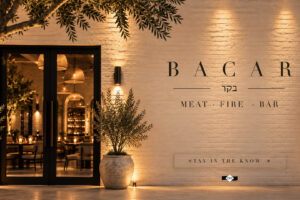






The numbers have been building for years, but new data on the restaurant industry finally make it plain: the United States has more restaurants than it can support (generally, not necessarily specifically for kosher). Supply has dramatically outpaced both population growth and consumer spending power since 2021, and the consequences are visible everywhere, from the wave of major chain bankruptcies to the steady drip of neighborhood closures that communities barely have time to mourn before the next one hits. The kosher dining world is not immune, but it has somewhat of an antidote.
A Supply Problem, Not a Demand Problem

According to data from Technomic, the leading restaurant industry research firm, the top 500 chain restaurant locations in the United States grew by 12.9% between 2021 and 2025. Over that same period, the U.S. population grew by just 3.2%, and the prime spending demographic, adults aged 25 to 54, grew by only 1.1%. The math is not complicated. More restaurants competing for a customer base that is barely growing is a structural problem, not a bad stretch of luck.
The just-released 2026 Technomic Top 500 Chain Restaurant Report, covering 2025 performance, confirmed the trend is accelerating. Total chain restaurant sales grew just 3% last year to $451.5 billion, a figure that fell below the 3.8% menu price inflation rate, meaning the average chain actually shrank in real terms. The median Top 500 chain saw just 2.5% sales growth, translating to a real-dollar decline once inflation is factored in. Technomic’s managing principal Joe Pawlak called it “a very, very weak year for the Top 500 overall from a sales perspective.” Yet unit counts still grew by 1.4%, with more doors opening into a market that was already struggling to fill the ones already there.
Independent restaurants have taken the hardest hit. According to Technomic, the independent restaurant sector shrank by 2.3% in 2025, dropping from 422,001 locations in 2024 to 412,498. That is nearly 10,000 independent restaurants that did not survive last year. A James Beard Foundation and Deloitte report found that 42% of independent operators said their businesses were not profitable in 2025, and 60% said their business conditions had deteriorated compared to 2024.
Inflation Pushed Diners Back to Their Own Kitchens

The oversupply problem is compounded by a parallel consumer behavior shift driven by years of persistent inflation. Restaurant menu prices surged as high as 9% year-over-year in 2022, and while the rate of increase has moderated, prices have not come back down. Full-service restaurant menu prices were up 4.3% as of early 2026 compared to a year prior. Critically, that increase has consistently outpaced grocery price inflation, which grew at a slower rate. The gap between the cost of eating out versus eating at home has widened to a point where a meaningful segment of consumers has made the rational decision to stay home.
A survey from CivicScience found that 57% of consumers were dining in more often, compared to 51% before the pandemic. A KPMG Consumer Pulse report from spring 2025 found that 69% of consumers said they were eating more at home, with 85% of that group citing cost savings as the reason. Consumers are expected to spend 7% less per month on restaurants in the summer compared to the prior summer. According to PYMNTS, 78% of surveyed consumers planned to eat at home more as an ongoing cost-saving strategy.
The bind this creates for restaurant operators is well-documented and genuinely brutal. Raising menu prices to cover rising food, labor, and rent costs drives customers away. Holding prices flat destroys margins. Restaurants that raised prices by more than 10% were most likely to report both lower profits and fewer customers, according to the James Beard and Deloitte data. There is no clean exit from this squeeze.
Areas with concentrated economic shocks felt it even more acutely. The Washington, D.C. market saw a surge of closures following federal government layoffs. Minneapolis-St. Paul experienced disruption tied to immigration enforcement. Tariff pressure in 2025 forced 68% of restaurant operators to raise prices even as they tried to hold the line, up from 47% in 2024.
The Kosher Market Is Feeling It Too
Every headwind hitting the broader restaurant industry hits kosher restaurants as well. Kosher certification requires ongoing rabbinic supervision, and most establishments operate with a mashgiach temidi on premises, a full-time supervisor whose salary is a fixed cost regardless of how busy the dining room is. Kosher meat and poultry costs significantly more than non-kosher equivalents. And operating Shabbat-compliant hours means being closed from Friday evening through Saturday night, plus chagim, eliminating what are typically among the most profitable dining windows of the week for any other restaurant.
The result is that a kosher restaurant needs to generate substantially more revenue per open hour than a comparable non-kosher restaurant just to break even. In an environment where consumers are dining out less frequently and scrutinizing every dollar, that is an extremely difficult position.
YeahThatsKosher has tracked a steady stream of kosher restaurant closures across the country over the past year and a half, spanning all regions and price points: New York, South Florida, Texas, California, the D.C. area, and beyond. The reasons behind any individual closure are often specific and varied, and each restaurant’s story is its own. But taken together, the volume and pace of closures reflects the same structural pressure that is squeezing independent restaurants across the broader industry.
We’ve recently seen numerous closures of kosher restaurants in Manhattan, specifically in Midtown and Lower Manhattan. While the closures are due to many factors, including fewer days of the week when people are coming into the office (for exmaple: I only go in to Midtown 2x a week for my day job), many are leaving NYC altogether, putting a strain on businesses that served a different dynamic pre-Covid.
Where the Opportunities Are: The Suburban Shift

Not every signal in the kosher restaurant market is negative. While established urban kosher corridors in parts of Manhattan have seen real contraction, the story is meaningfully different in the suburbs, and that gap matters for anyone thinking about where the kosher dining market is actually headed.
Orthodox Jewish families have been leaving New York City (the biggest city in terms of Jewish population) in significant numbers, driven by affordability, quality of life, and in some cases, political climate. The communities absorbing that migration are seeing it show up in the data. The most dramatic example is Lakewood, New Jersey, in Ocean County, which grew by 45.6% between the 2010 and 2020 Census, making it the fastest-growing municipality in the state and now the fifth-largest city in New Jersey. The Census Bureau’s population estimates put Lakewood at nearly 142,000 residents in 2024, up from 92,843 in 2010. Its birth rate, driven by large Orthodox families, tops 5,000 births per year, more than Newark, a city twice its size. Lakewood’s growth is also spilling into neighboring Ocean County towns like Toms River and Jackson as the township itself becomes more dense. Ocean County as a whole was the second-fastest-growing county in New Jersey in the 2020 Census.
In New York, the Town of Ramapo in Rockland County, which encompasses Monsey and surrounding Orthodox communities, grew from 108,905 residents in 2000 to 148,919 in 2020. Monsey itself recorded a 46% population increase in that same Census period, with a median age of 15.7 years, a direct reflection of large family sizes. Rockland County has been described as having the largest Jewish population per capita of any county in the United States. Jewish day school enrollment in Rockland County grew 139% over a recent 20-year period, one of the most striking indicators of community expansion anywhere in the country.
On Long Island, the Five Towns and its expanded footprint into North Woodmere, Far Rockaway, and adjacent communities continues to attract Orthodox families, with some areas estimated at 69% to 75% Orthodox Jewish. The UJA-Federation’s community study data identifies the Five Towns as one of the most concentrated Orthodox markets in the entire New York region.
In South Florida, a 2024 community study found that the Jewish population of Miami-Dade County grew 7% over the prior decade, with the number of Jewish children growing 13%, a clear leading indicator of further community expansion. The study found South Florida’s Jewish population skews more Orthodox than the national Jewish average, with 13% identifying as Orthodox compared to 9% nationally. Boca Raton, with an estimated 85,000 to 100,000 Jewish residents, has approximately 70% of its population identifying as Jewish, one of the highest percentages of any city in the United States. The community there has seven Jewish day schools, all reported to be operating at capacity.
These are real, growing markets with concentrated Orthodox populations and demonstrated demand for kosher infrastructure. New kosher restaurant openings in these communities have more natural tailwinds than openings in saturated urban environments where competition is fierce and rents are prohibitive.
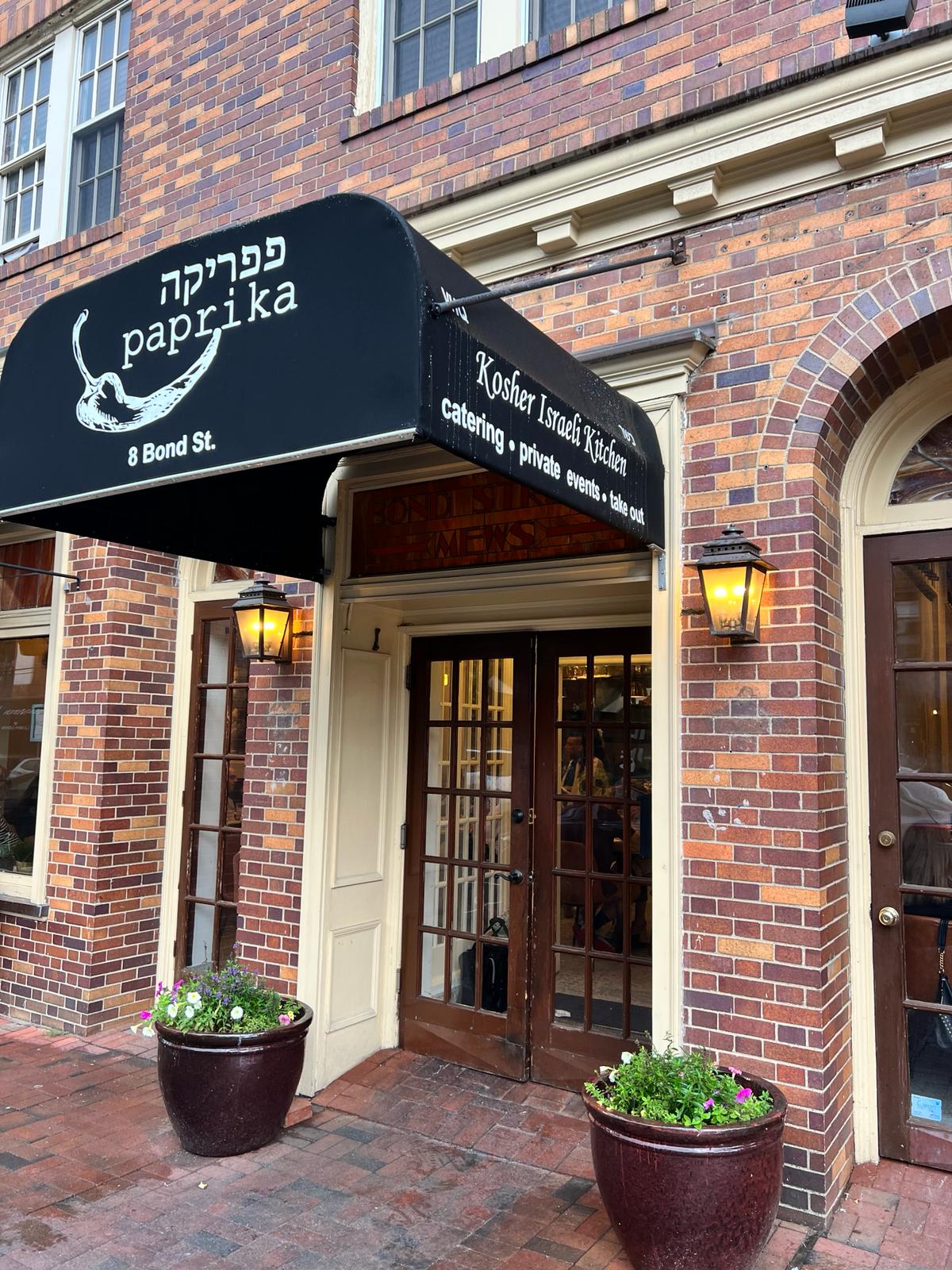
The Paprika story is perhaps the clearest illustration of this shift in action. The Israeli restaurant operated for years in Midtown Manhattan, building a loyal following among kosher diners working and visiting in the area. When the Manhattan location permanently closed in 2022, citing the drastic drop in Midtown foot traffic that never fully recovered post-pandemic, it looked like the end of the brand in New York. Instead, the owners relocated to Great Neck and reopened there in 2023. The result: a community that surrounds the restaurant, with a dense, walkable Orthodox population and consistent local demand rather than dependence on commuters and office workers. The Great Neck location has performed well enough that the team just launched a second concept this week: Elisha, a fast casual Israeli shawarma restaurant in the same market. Colbeh, the Persian kosher restaurant that shared the old Manhattan space with Paprika, tells the same story from a different angle. Its Midtown location is gone, but its two Nassau County locations in Great Neck and Roslyn continue to operate, anchored in communities where the customer base lives rather than passes through.

But even in these growth markets, there is a ceiling, and it matters. A community can support only so many restaurants, and it cannot support all of them being expensive. Not every new opening can be an upscale steakhouse or an omakase concept. The community has a finite appetite for premium dining, and it is already stretched thin by the financial obligations that define Orthodox life at every income level.
The Orthodox Consumer’s Real Disposable Income Problem
Here is the counterargument that always comes up: the Orthodox Jewish community has a significantly higher birth rate than the general U.S. population. Pew Research data confirms that Orthodox Jews average more children per family than the national average, and projections suggest the Orthodox share of American Jewry is growing rapidly, with 27% of Jewish children under 18 living in Orthodox households according to Pew analysis. A growing community means a growing potential customer base, and that does provide a genuine long-term tailwind for kosher restaurants that the broader industry does not have.
But population growth and dining spending power are not the same thing, and in the Orthodox community specifically, the gap between them is wide.
Orthodox Jewish families face a cost structure that most Americans simply do not. Yeshiva day school tuition is not discretionary; it is the baseline cost of participation in the community. Tuition ranges from roughly $10,000 to more than $25,000 per child per year depending on location and school, and many families have multiple children enrolled simultaneously. A family with three school-age children can easily be paying $40,000 to $60,000 or more annually in tuition after taxes, before a single other expense beyond rent and groceries. The kosher food premium at the grocery level adds further cost. Synagogue membership, community infrastructure, and other obligations layer on top.
The Orthodox Jewish consumer is, in many cases, a financially stretched consumer even when household income looks solid on paper. The money is allocated well before they consider where to eat dinner. And when they do go out, the decision involves real trade-offs that non-observant consumers in similar income brackets simply do not face to the same degree.
This dynamic is part of what we explored in depth in our earlier piece on why mid-tier kosher restaurants are getting squeezed. The short version: kosher restaurants are being pushed toward higher price points by their cost structure, but landing in the $30 to $50 per person range puts them in a decision zone where customers start comparing every dollar against other options, both kosher and not. The middle of the market is the hardest place to survive right now, and kosher restaurants are disproportionately forced to live there.
What Comes Next
The broader restaurant industry is working through a painful but necessary correction. Too many locations were built into a market that changed faster than anyone anticipated, and the reconciliation is ongoing. The kosher market is navigating the same correction with its own added layers of complexity.
The communities that will support kosher restaurant growth are increasingly suburban rather than urban, driven by where the population is actually going. The concepts most likely to survive are those with a clear value proposition, efficient operations, and price points that reflect the real financial constraints of the community they serve. And the era of assuming that a kosher certificate alone is sufficient to sustain a restaurant is definitively over.
None of this is a reason for pessimism about kosher dining. The demand is real, the community is growing, and good operators continue to build things worth supporting. But building something that lasts in this environment requires a clear-eyed understanding of what the market actually looks like, not what it looked like five years ago.