

































Asking ChatGPT, Claude, or Google whether a restaurant is kosher, whether a hotel has a kosher option, or whether a product carries a valid hashgacha is not a reliable way to get a kosher answer. It can be a dangerous one. AI tools and Google’s AI-powered search summaries get this wrong regularly, and the consequences for a shomrei kashrus consumer are not minor inconveniences. They are actual kashrus failures.
This is not a theoretical concern. It is happening to kosher consumers right now, and it is worth talking about directly.

What AI Actually Does With Kosher Information
Large language models like ChatGPT, Claude, and Google’s Gemini do not have a live connection to a database of kosher certifications. They are trained on data scraped from the internet up to a certain cutoff date, and that data includes restaurant websites, blog posts, old Yelp listings, forum discussions, and articles written at some point in the past. The model learns from all of it and then synthesizes an answer that sounds authoritative, whether or not the underlying information is still accurate.
Here is the core problem: kashrus status changes constantly. A restaurant that was certified by one agency last year may have switched agencies, lost its certification due to violations, or closed entirely. A product that carried a hechsher in 2024 may no longer carry one. A hotel that offered a kosher meal option during a particular season may not offer it anymore. None of that fluidity is captured in an AI’s training data, and the model has no mechanism to flag its own uncertainty. It will tell you something is kosher with the same confident tone, whether that answer is current and accurate or three years out of date.
Hallucination compounds the problem. AI tools do not just pull from old data. They sometimes generate information that never existed at all. A certification agency that the model has never seen in its training data may be invented wholesale. A phone number, address, or supervision detail may be plausible-sounding fiction. The model is designed to produce a coherent, complete-sounding answer, not to admit the limits of its knowledge.
Google’s AI Overviews Are Not Any Better
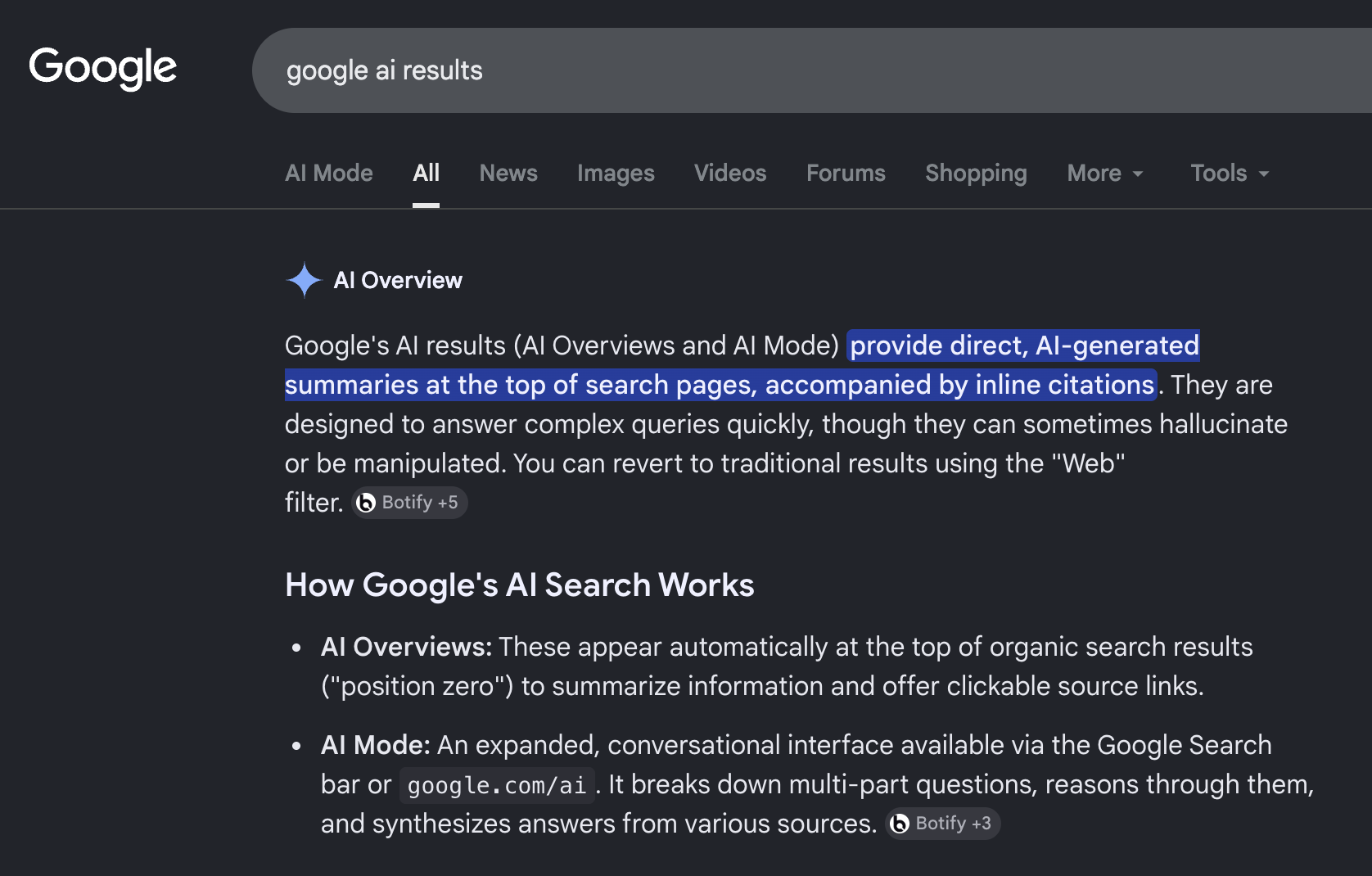
Google’s AI Overviews, the summaries now appearing at the top of many search results, carry the same structural problems with an additional layer of risk: many consumers assume that because it’s Google, it must be right.
According to Google itself: “Google’s AI results (AI Overviews and AI Mode) provide direct, AI-generated summaries at the top of search pages, accompanied by inline citations. They are designed to answer complex queries quickly, though they can sometimes hallucinate or be manipulated.”
Multiple documented cases in the mainstream press illustrate what happens when Google’s AI summarizes information about restaurants and businesses. A Montana restaurant was forced to post a public notice after Google’s AI kept telling customers about daily specials that did not exist, causing frustrated diners to argue with staff about prices that were never offered. The restaurant’s response was blunt: they cannot control what Google posts, and they will not honor what Google’s AI says.
In another documented case, Google’s AI told diners that a restaurant served brunch on a day it did not. The AI, as one food industry publication put it, “wanted so badly to produce a relevant answer” that it sourced confidently from incorrect underlying data. The business had no way to prevent it and no recourse once the damage was done.
Google itself acknowledged the problem when its AI Overviews launched, noting that the feature can and will make mistakes. That acknowledgment has done nothing to slow the feature’s rollout into search results that millions of people see every day.
Now apply that same dynamic to kosher status. If Google’s AI will invent a brunch service or fabricate a pizza special, it will absolutely tell you that a restaurant is kosher certified when the certification was revoked six months ago. It has no idea. And it will not tell you it has no idea.
Kosher Status Changes in Ways AI Cannot Track
Kashrus is not static. Certifications are revoked for violations. Agencies switch. Standards are updated. What was acceptable last year is sometimes not acceptable this year.
In February 2025, Kosher Miami revoked certification from two South Florida establishments after finding that non-certified cheese had been used in the kitchen for an extended period, with rabbinic guidance issued about the need for kashering. In April 2025, a well-known Orlando restaurant lost its hashgacha from RCF following kashrus violations and non-compliance. In March 2025, a popular retail chain had its national kosher certification revoked following product concerns. Each of these developments was real, time-sensitive, and consequential for any consumer who had relied on information about those establishments from weeks or months prior.
In November 2025, the OU issued a sweeping new policy changing the kosher status of unflavored beer across the board, a category that had been assumed permissible for decades. What was considered fine to drink at your Shabbos table in 2024 now requires a hechsher to be considered reliably kosher. An AI that trained on any data before that announcement will not know this. It will tell you beer is fine. That answer is no longer correct.
These are not edge cases. This is the normal operating reality of kashrus in a world where standards evolve, businesses change, and certifications are earned and lost on an ongoing basis.
Any Kosher Status Can Change Overnight
The AI reliability problem is not limited to restaurants. It applies to every category of kosher certification that exists, and that list is longer than most consumers think about on a daily basis.
Packaged food products lose and gain certification constantly. A snack brand that carried an OU symbol in 2023 may have reformulated, switched manufacturers, or let the certification lapse. A candy that was pareve for years may have shifted to dairy equipment. A beverage that was assumed permissible without a hechsher may now require one, as happened across the entire beer category when the OU issued its sweeping new policy in late 2025. None of those changes show up in an AI answer. The model learned from data that predates the change, and it has no way to know what it does not know.
Retail stores and grocery chains with kosher sections operate under specific supervision agreements that are renegotiated, transferred, or terminated. A store’s kosher bakery may have been certified by one agency last year and a different agency this year, or none at all. The prepared foods counter at a supermarket may carry a hechsher on some items and not others, with distinctions that are not obvious to someone walking the aisle, let alone to an AI summarizing a years-old blog post about that store’s kosher offerings.
Caterers and event venues present a particular challenge. Kosher catering certifications are often event-specific or tied to individual mashgichim rather than standing institutional arrangements. A venue that hosted a fully kosher wedding under a specific hashgacha last year may have no kosher supervision at all for your event unless it is explicitly arranged. AI has no visibility into any of that. It sees a venue described somewhere online as having hosted kosher events and concludes, confidently, that the venue is kosher.
Hotels and resorts with kosher dining programs are among the most frequently misrepresented category in AI search results. A resort may have run a kosher program during one season and discontinued it. A hotel that partnered with a local kosher caterer for a period may have ended that relationship. A cruise line’s kosher meal option involves pre-ordering, specific supervision arrangements, and conditions that vary by sailing, none of which an AI summary will accurately convey. What gets indexed on the internet is often a press release or travel article written at the time of a program’s launch. That article lives online indefinitely. The program may not.
Manufacturers are another area where the gap between AI answers and current reality can be significant. Production lines change. Facilities add new products that affect the kosher status of existing ones. A company may produce both kosher and non-kosher runs of what appears to be the same product, with the distinction visible only on the packaging in hand. Kosher certification for a manufacturer is not a permanent designation. It requires ongoing compliance, and agencies do pull certifications when that compliance breaks down, sometimes with public alerts and sometimes quietly.
The common thread across all of these categories is the same: kosher status is a living designation that requires active maintenance, and any information source that cannot reflect changes in real time is unreliable for kashrus purposes. AI does not reflect changes in real time. It reflects a snapshot of the internet from its training period, presented without a timestamp and without any indication of how old or incomplete that snapshot might be.
The Timestamps That AI Does Not Show You
One of the things that makes kosher-specific resources valuable is transparency about when the information was written. Here at YeahThatsKosher.com, every article carries a date. Every restaurant guide, every certification update, every travel piece was written at a specific point in time. Readers can look at the timestamp and ask themselves: is this information recent enough to rely on? That context lets the consumer make an informed decision about whether to verify before they act.
AI summaries do not give you that. There is no timestamp on a ChatGPT answer. There is no “this information is from training data through mid-2024” disclaimer attached to the confident paragraph Google serves you at the top of your search results. The answer arrives as if it were current, sourced, and reliable. It may be none of those things.
For a consumer making everyday decisions, an AI confidently telling you a restaurant is open and kosher certified can be the end of the inquiry. That is exactly where the risk lives.
The Platform That Is Always Trying to Keep Up
The KosherNearMe app exists specifically because kosher status requires ongoing, human-maintained curation. The database is updated continuously as restaurants open, close, change agencies, or lose certifications. It is not perfect, and no database ever will be, but the intent is to reflect current reality as closely as humanly possible rather than to summarize whatever happened to be on the internet at some point in the past.
Certification agencies like the OU, cRc, OU, Kof-K, Kosher Miami, COR, MK, and others maintain their own public lists of certified establishments. These are the primary sources. They are updated by humans who are actively engaged in the certification relationships. Checking directly with the agency that supervises a specific establishment is always the most authoritative answer available.
How to Actually Verify Kosher Status
If you are relying on any single source, including this one, without confirming the current status of an establishment before eating there, the standard practice within our community applies: if in doubt, ask.
The practical steps when traveling or visiting a new establishment are straightforward. Check KosherNearMe for the most current listing. Cross-check with the certifying agency’s website or hotline directly. Call the restaurant and ask who their hashgacha is and confirm the agency is actively certifying them. If the restaurant cannot provide a clear answer, that is itself informative.
For products, check the packaging in hand, not a photo from the internet. Labels change. Certifications are added and removed. The symbol on the box in front of you is the answer. The symbol someone photographed and posted two years ago is not.
For hotels and resorts with listed kosher options, confirm with the property directly and ask who is supervising the option you intend to use. Hotel kosher programs vary widely in their standards and oversight, and what a resort’s website says about their kosher offerings may not reflect what is actually available or under what supervision when you arrive.
The Broader Pattern
This is not an argument against using technology. It is an argument for understanding what technology actually does so you can use it appropriately.
AI tools are good at summarizing large amounts of text, generating ideas, and helping with tasks where accuracy can be verified by the user. They are poorly suited to any task where the information needs to be current, where the consequences of being wrong are significant, and where the user cannot easily check the output against a reliable real-time source.
Kosher status hits all three of those criteria simultaneously. It needs to be current. Being wrong has real kashrus & halachic implications. And the average consumer doing a quick Google search before lunch is not cross-referencing the AI summary against the certifying agency’s live database.
We have written before on this site about the tendency within our community to outsource our thinking on kashrus, to assume that someone else has already checked, that if a place looks Jewish or frum it must be fine, that the app or the website or the search result would have said something if there were a problem. AI and Google’s AI summaries are the newest and most seductive version of that tendency. The answer arrives quickly, confidently, and in clean langauge. It feels authoritative. It may be wrong.
Shmiras kashrus has always required personal vigilance. That has not changed. What has changed is that there is now a new category of source that looks like an answer but may not be one. Treat it accordingly.
For the most current kosher restaurant and business listings, use the KosherNearMe app. For kosher travel information with full date context, YeahThatsKosher.com has been covering kosher dining and travel since 2008. When in doubt, confirm directly with the certifying agency. That has always been the answer, and it still is.