









































My family does not have a casual relationship with skin cancer. It shows up on both sides. Once a year I sit in a paper gown under fluorescent light while my dermatologist runs a dermatoscope over every inch of my skin, and I have learned not to flinch when he pauses a little too long on something. That is not anxiety talking. That is just what it means to come from a family where skin cancer is not a hypothetical. So when the FDA approved a brand new sunscreen active ingredient for the first time in close to three decades, I did not read it as a beauty industry headline. I read it as the most consequential piece of sun protection news of my lifetime, and I wanted to actually understand the data behind it before writing a word about it.
What Actually Happened, and Why It Took 27 Years
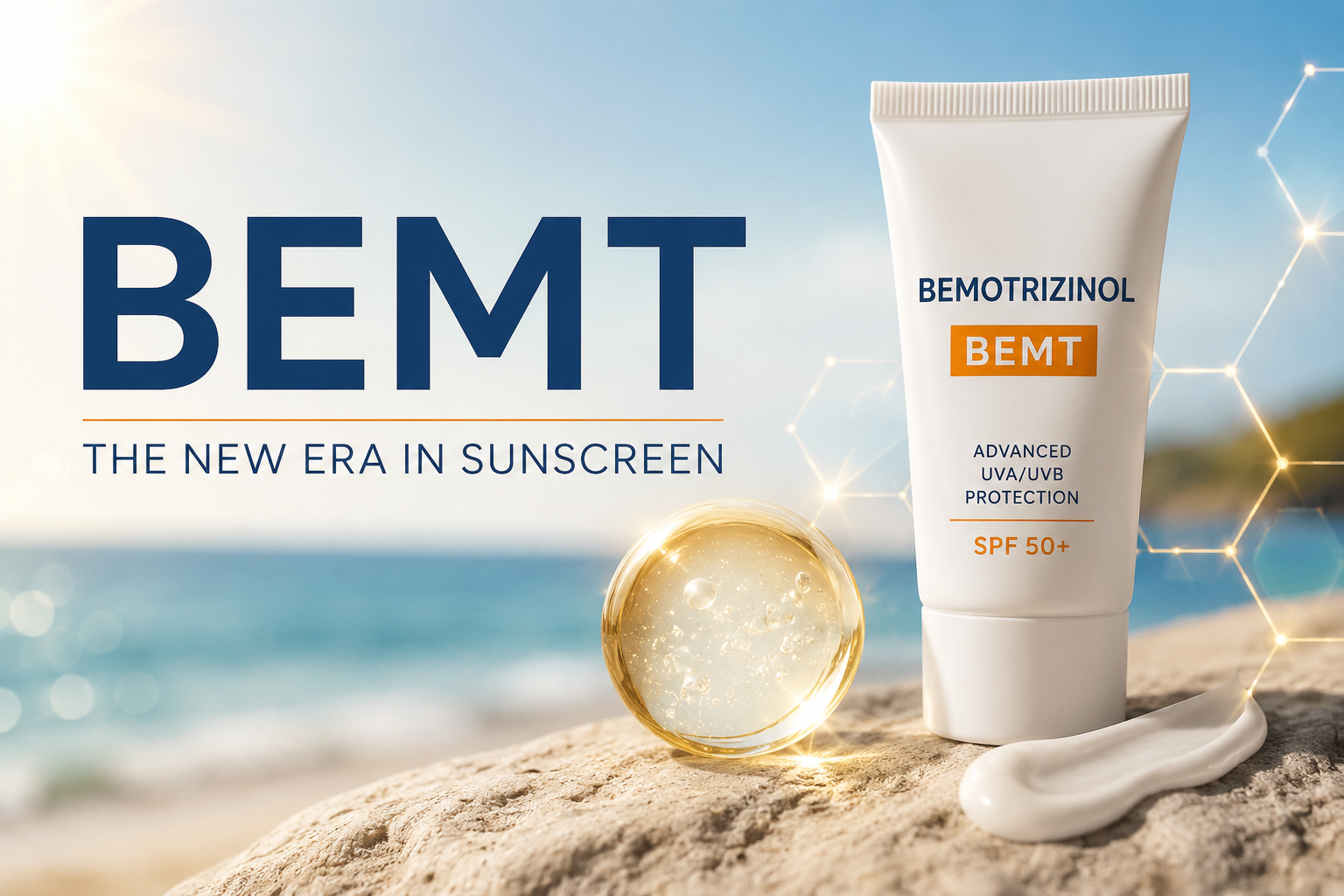
On June 9, 2026, the FDA issued a final order adding bemotrizinol, known as BEMT, to the official list of permitted sunscreen active ingredients in the United States. It is the first new sunscreen filter approved here in more than 25 years. To put that in perspective, the last time the FDA added a new sunscreen ingredient, I was still buying disposable cameras.
BEMT is not actually new. It has been used safely in Europe since 1999 under the name Tinosorb S, and it is also sold internationally as Parsol Shield. It was first filed with the FDA for review back in 2005, and its manufacturer DSM began a fresh round of FDA-requested studies in 2019, according to CBS News. The ingredient sat in regulatory limbo for two decades while millions of people overseas used it without incident.
HHS Secretary Robert F. Kennedy Jr. framed the approval as overdue progress, stating that the FDA’s final order adds bemotrizinol to its list of approved sunscreen ingredients and declares it generally recognized as safe and effective, and separately that bemotrizinol has been used safely in Europe for decades and the FDA’s action will increase competition and consumer confidence in sunscreen products. David Andrews, chief science officer at the Environmental Working Group, which had pushed for this approval since 2019, was blunter in EWG’s statement about what the delay cost American consumers: “For decades, Americans have used outdated sunscreen tech while the rest of the world moved forward.”
Why This Ingredient Is Different
For someone who has spent years reading sunscreen labels like they were medical charts, the science here matters. Bemotrizinol is a chemical filter that absorbs both UVA and UVB radiation, the two primary types of ultraviolet rays that cause skin damage and increase cancer risk. That single-molecule broad spectrum coverage is the real story. Most chemical UV filters currently approved in the U.S. are either UVB-only, like octinoxate, octisalate, and homosalate, or UVA-only, like avobenzone. BEMT covers both ranges by itself, with two distinct absorption peaks around 310 and 340 nanometers.
The UVA gap is not a minor technical detail. UVA rays are the wavelength that penetrates deepest into skin, and they are directly tied to the cancer risk my family has dealt with. As the Environmental Working Group explains, “UVA radiation is the sun wavelength that penetrates deepest into the skin, leads to premature skin aging, suppresses the immune system and increases risk of skin cancers, like melanoma.”
It also solves a stability problem that anyone who reapplies sunscreen at the beach has run into. Bemotrizinol offers a stable non-mineral option that doesn’t break down in the sun, unlike one of two previously approved UVA filters, avobenzone. Avobenzone, the main UVA filter currently used in American sunscreens, degrades under sunlight, which means it can lose effectiveness during the exact hours you are counting on it most. CBS News medical correspondent Dr. Jon LaPook noted that bemotrizinol also isn’t as easily broken down by the sun as currently available sunscreens, meaning the protection lasts longer.
There is also a safety angle that I, as someone with a family cancer history, take seriously. Several chemical filters used in American sunscreens for years have been flagged for unexpectedly high systemic absorption. BEMT does not appear to share that problem. Data submitted to the FDA confirms that at concentrations up to 6%, bemotrizinol is minimally absorbed through the skin, with average absorption levels below the concentration the FDA considers indicative of systemic exposure. Dr. Nisha Varadarajan, a dermatologist at Memorial Sloan Kettering Cancer Center, told USA Today that “Bemotrizinol would be the first chemical UV filter recommended to be used on infants due to minimal skin irritation.” The FDA has in fact cleared it for use on children as young as six months.
The Numbers That Made Me Take This Seriously
I am not someone who needs convincing to wear sunscreen, but the current melanoma data is still worth sitting with, especially if you have any family history at all. According to the American Cancer Society’s 2026 Facts and Figures report, an estimated 234,680 cases of melanoma will be diagnosed in the U.S. in 2026, with 112,000 of those invasive. That represents a projected 10.6 percent increase in new melanoma diagnoses this year alone, and looking back further, the number of new invasive melanoma cases diagnosed annually increased by 46.6 percent between 2016 and 2026.

New invasive melanoma diagnoses have climbed from an estimated 76,400 in 2016 to 112,000 in 2026, a 46.6 percent increase over the decade. The 2016 and 2026 figures are sourced directly from the Skin Cancer Foundation and American Cancer Society; the years in between are a smoothed estimate showing the overall trend, not independently reported annual totals.
The age pattern is the part that hit closest to home for me. While overall melanoma incidence rates have stabilized among women under 50 and have declined by about 1 percent per year in men under 50, rates in adults 50 and older continue to increase, by almost 2.8 percent per year in women and 1.4 percent in men. If you have a parent, aunt, or uncle who has had a basal cell, squamous cell, or melanoma diagnosis, this is precisely the demographic where risk is still climbing, not leveling off.
Family history compounds that risk directly. The American Academy of Dermatology notes that excess exposure to UV radiation from sunlight or use of indoor tanning increases risk for all skin cancer types, as does a personal history of the disease, and lifetime risk statistics make the stakes concrete: lifetime risk of getting melanoma is about 3 percent for white people, or 1 in 33. Dr. Jesse Miller Lewin of the Icahn School of Medicine at Mount Sinai told Medscape that part of the rise reflects better detection, but cautioned that “we certainly do see melanoma in young people,” and flagged a newer threat working against all of this progress: online misinformation claiming sunscreen itself is dangerous. “There’s a lot of misinformation out there that is being propagated in a way that it couldn’t have been before social media,” he said, warning it could affect skin cancer rates over the next decade if people act on it.
The one piece of genuinely good news in the data is that earlier detection and treatment advances are saving lives even as diagnoses climb. Age-adjusted death rates have been falling on average 2.2 percent each year over the past decade, and survival for advanced disease has improved dramatically. None of that is a reason to skip a dermatology visit. If anything, it is the reason mine actually find things early.
When You Will Actually Be Able to Buy BEMT-Based Sunscreen Here
This is where I want to be straight with you, because a lot of coverage is glossing over the timeline. Approval is not the same as availability. According to dermatologist Dr. Jane Yoo’s breakdown of the rollout, the FDA’s final order takes effect on August 9, 2026, the date bemotrizinol officially becomes usable in U.S. over-the-counter sunscreen products under the updated monograph. DSM Nutritional Products holds an 18-month U.S. marketing exclusivity window for its Parsol Shield formulation, and bemotrizinol will initially be sold in the U.S. under the brand name Parsol Shield, expected to launch later this year, with other manufacturers able to use the ingredient after the exclusivity period ends.
Even after that, brands need time to formulate and test. Realistically, the first U.S. products with bemotrizinol as a listed active ingredient will likely appear in late 2026 to early 2027, with broader availability in 2027. So if you go looking for a U.S.-made bottle that says bemotrizinol on the label right now, you will not find one yet.
What You Can Actually Buy Today
Here is the practical workaround, and the one I have personally relied on for sunscreen shopping for a while now. The exact same molecule has been sold abroad under the name Tinosorb S since 1999, and a number of internationally formulated sunscreens containing it are already sold legally on Amazon, often through authorized importers. These are not U.S.-monograph products, so the labeling and regulatory pathway differ from what will eventually carry the bemotrizinol name domestically, but the active ingredient is chemically identical to what the FDA just approved.
A few well-reviewed international options are currently available:
- La Roche-Posay Anthelios, a lightweight French pharmacy facial sunscreen built around Tinosorb S, widely recommended by dermatologists for daily wear under makeup.
- Biore UV Aqua Rich Watery Essence SPF 50+ PA++++, a Japanese formula that consistently tests well for even coverage and a non-greasy finish, and is already sold through Amazon.
- Beauty of Joseon Relief Sun: Rice + Probiotics, a Korean formula combining Tinosorb S with other next-generation filters, frequently cited by dermatologists as a favorite for sensitive skin with no white cast.
How to Protect Yourself in the Meantime
None of this is a reason to wait for new formulas to hit shelves. The basics still do almost all of the work. The American Academy of Dermatology and most dermatologists quoted across this coverage agree on the same core habits, and given my own family history, these are not optional for me.
Use a broad-spectrum sunscreen of at least SPF 30, and reapply roughly every two hours, more often if you are swimming or sweating. Fort Lauderdale dermatologist Dr. Matthew Elias, quoted in NewBeauty’s review of the latest skin cancer data, also recommends layering on additional physical protection: UPF 50 clothing, shade, and sunglasses as added protection beyond sunscreen alone. If you have a family history of skin cancer of any kind, do not wait for a mole to look suspicious before seeing a dermatologist. Annual full-body checks, or more frequent ones if your doctor recommends it, are how the people I love who have had skin cancer caught it early enough to treat successfully.
And if you see sunscreen described online as dangerous or unnecessary, be skeptical. That claim is not supported by the dermatology and FDA data above, and acting on it is the one thing that could actually undo the progress this approval represents.
Disclosure: As an Amazon Associate, we earn from qualifying purchases. Learn more