



































Hat tip to @bagelambassador for bringing this to our attention.
A bill that has gotten almost zero attention in the broader Jewish community just passed the New York State Assembly and Senate, and if Governor Kathy Hochul signs it into law, it could fundamentally change the texture, cost, and production of two foods that are essentially bedrock items in the kosher world: the New York bagel and the New York pizza pie.
The legislation is called the Food Safety and Chemical Disclosure Act. It bans three food additives from being manufactured, distributed, or sold in New York State: Red Dye 3, propylparaben, and potassium bromate. For most people, two of those are background noise. The third one, potassium bromate, is the one that matters to every kosher bakery, bagel shop, and pizza place in New York.
What Is Potassium Bromate and Why Does It Matter?
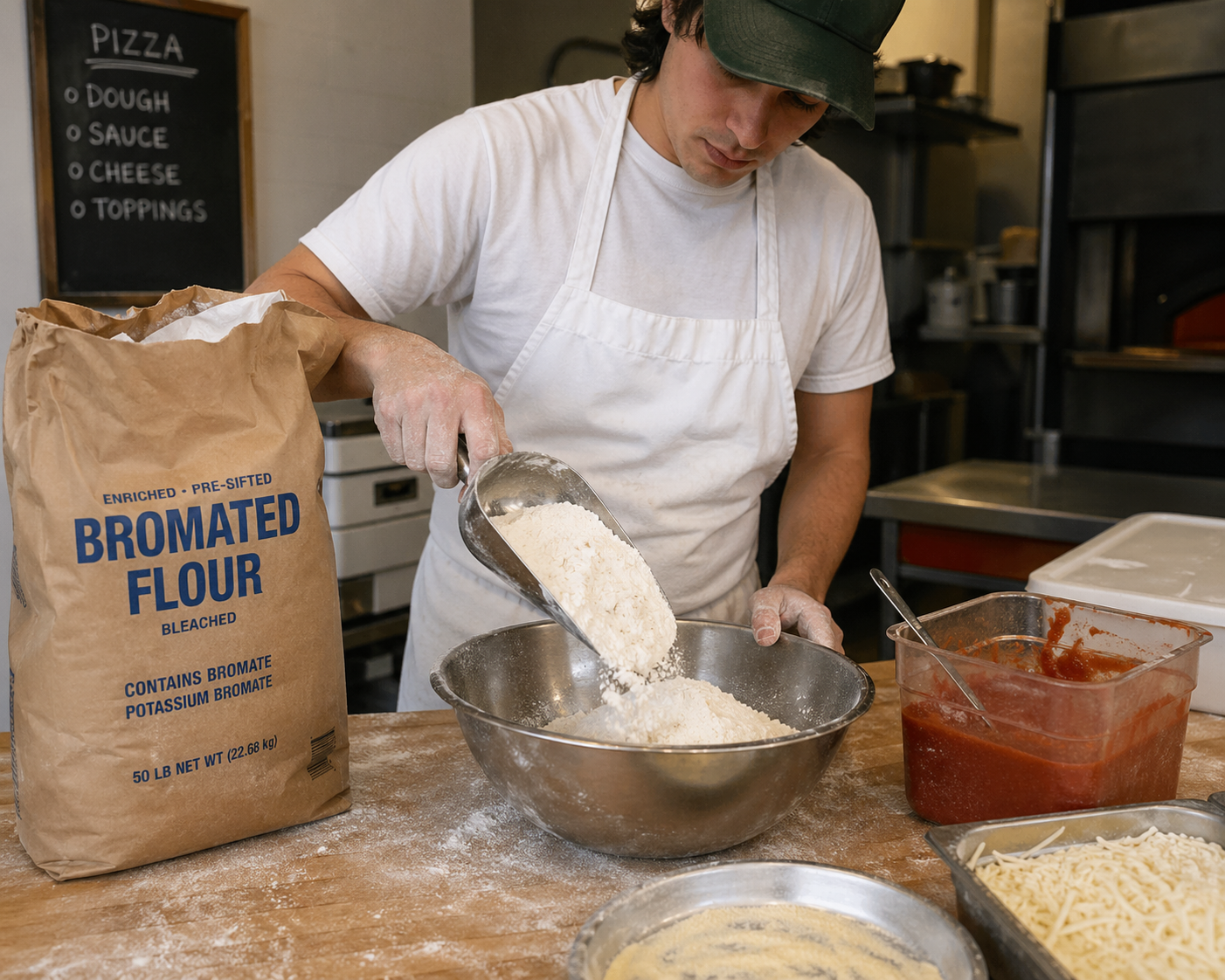
Potassium bromate is a flour additive, technically classified as an oxidizing agent, that has been used in commercial baking for decades. It strengthens dough, improves elasticity, reduces mixing time, and dramatically increases oven spring. That last part is key. Oven spring is what gives a bagel that tall, airy, rip-apart interior that New York is famous for. It’s what lets pizza dough stretch thin without tearing and still hold its structure in the oven.
Bromated flour is not some obscure industrial chemical. It’s sitting on the shelves of virtually every kosher bakery and bagel shop in New York. The two most dominant flours used by New York bagel shops are Gold Medal All-Trumps and Pillsbury High-Gluten. Both are bromated. Gold Medal All-Trumps, with its 14.2% protein content, lists potassium bromate right on the ingredient panel alongside wheat flour, malted barley flour, niacin, iron, and the standard B vitamin enrichments. It is certified kosher by the Orthodox Union. It is also, under this legislation, going to become illegal to use in New York.

The Health Concern
The World Health Organization flagged potassium bromate as a potential carcinogen back in 1992. The FDA has never meaningfully reviewed it for safety since 1973. In the decades since, Canada, China, India, Brazil, the European Union, and a long list of other countries all banned it from food production. California became the first U.S. state to ban it in 2023 under the California Food Safety Act, with that ban taking effect in 2026. New York just followed.
The New York bill passed the State Senate with a unanimous 60-0 vote. The Assembly passed it 106-32. That kind of bipartisan support for a food safety bill is not common. The legislation is supported by the Center for Science in the Public Interest, Consumer Reports, the Environmental Working Group, and the Environmental Defense Fund.
The argument against potassium bromate is not that it will definitely cause cancer in people who eat a bagel. The argument is that it’s been linked to kidney, thyroid, and gastrointestinal cancers in animal studies, that it has never been properly evaluated by the FDA under modern standards, and that every other developed country has decided it’s not worth the risk when perfectly functional alternatives exist.
What This Means for the Kosher Bagel
Here is where this gets specific and practical for the kosher consumer. The New York-style bagel, meaning the dense-but-airy, chewy, high-rise bagel that defines the form, is built on high-gluten bromated flour. The bromate is not incidental. It is part of the formula. It reduces the amount of mixing time needed to develop gluten, and it produces more oxygen in the dough during baking, which contributes to that rise and open crumb structure.
The two workhorse flours in the kosher bagel world, All-Trumps and Pillsbury High-Gluten, are both going away if this law takes effect. General Mills, the parent company of Gold Medal, does make an unbromated version of All-Trumps under a green label (item 50143). But professional bakers who have worked with both versions will tell you the results are not identical. The unbromated version requires longer fermentation times, different hydration ratios, and more hands-on dough management to get comparable results. That costs time and money.
The good news is that unbromated high-gluten flours do exist and do work. King Arthur Flour has built its entire brand identity around being “Never Bleached, Never Bromated.” A significant percentage of the newer-generation kosher bagel shops that have opened in recent years already use King Arthur. These shops tend to be more artisan-focused, with longer fermentation processes and a willingness to invest more in ingredients. Their bagels are excellent. But they also typically charge more per bagel than the old-school shops.
The kosher establishments that will feel this most are the high-volume, lower-margin bagel shops that have run on the same All-Trumps formula for 20 or 30 years. Switching flour mid-operation is not just swapping one bag for another. It means retesting recipes, adjusting water ratios, extending fermentation times, potentially retraining staff, and absorbing cost differences. For a shop that moves hundreds of dozens of bagels a week, that transition has real financial weight.
What This Means for Kosher Pizza
The impact on kosher pizza is going to be just as significant and has gotten even less attention. New York-style pizza dough relies on high-gluten bromated flour for the same reasons as bagels: elasticity for stretching, strength for a thin crust that doesn’t fall apart, and a crisp-chewy texture that defines the style. All-Trumps is an industry standard in pizzerias across the five boroughs, Brooklyn, Queens, and the broader New York metro area. This is as true in kosher pizza shops as it is everywhere else.
Operators in the non-kosher pizza world who have already made the switch, such as those importing Italian “00” flour, report excellent results but acknowledge a meaningful cost increase. Imported Italian flour runs significantly higher than domestic bromated alternatives. For a kosher pizza shop operating on tight margins, with the added costs of kosher supervision, mashgiach temidi staffing where required, and kosher-certified ingredients across the board, absorbing a flour cost increase is not trivial.
The Timeline and What Happens Next
As of this writing, the Food Safety and Chemical Disclosure Act has passed both chambers of the New York State Legislature and is awaiting Governor Hochul’s signature. The bill passed the Assembly on April 21, 2026, which means Hochul has until May 1 to sign it or let it become law automatically. Once enacted, flour distributors will have one year to transition their New York clients to unbromated flour. Restaurants and bakeries will be able to continue using any bromated flour already in their inventory until those bags’ expiration dates run out.
That runway gives operators some breathing room, but it is not unlimited time. Kosher bakeries and bagel shops that have not already been testing unbromated flour alternatives should start now. The transition will be easier with experimentation time than without it.
The Broader Picture for Kosher Consumers
There is something worth sitting with here. Potassium bromate has been banned in most of the world for decades. The flour that is going into your local kosher bagel shop’s dough every morning has been illegal in Canada, the EU, and dozens of other countries since the 1990s. The Orthodox Union certifies it as kosher, which it is, because kosher certification addresses Jewish law, not public health. Those are two separate categories.
This law does not change the kosher status of anything. It changes what ingredients are legally permitted in the state. But for a community that already spends significant energy thinking about what goes into food, the question of whether we want bromated flour in our bagels is worth asking.
The good news for kosher consumers is that the industry has the tools to adapt. Unbromated high-gluten flours produce excellent bagels and pizza when handled correctly. The new-age kosher bagel shops that have opened in recent years, places that ferment their dough longer and source better ingredients, have already demonstrated this. The transition may cost more. It will require adjustment. But the New York kosher bagel is not going anywhere. It is going to change, and for the health of everyone eating it, that is probably the right outcome.
A Prominent Kosher Chef Weighs In
Not everyone in the kosher food world is hand-wringing over this. Chef Isaac Bernstein, one of the most respected culinary voices in the kosher industry, shared his take on Instagram Stories this week, and he did not mince words.
“People complaining about this bromate ban really need to check themselves,” Bernstein wrote. “It 100% causes illnesses such as cancer. Most 1st world countries banned it years ago. Pizzerias and bagel stores that feel the need to whine like little babies about this need to chill out and get with the times.” He added: “Let’s ban bleached flour next. While we’re at it let’s stop spraying our crops with poison. Let’s stop injecting our beef with all sorts of trash.”
For context, Bernstein is not some outside observer. He trained at the French Culinary Institute and the San Francisco Baking Institute, developed the food program at Pomegranate Supermarket in Brooklyn, one of the most prominent kosher markets in the country, and recently served as Culinary Director at Reserve Cut, the acclaimed kosher steakhouse in Manhattan’s Financial District. He has also been involved in the menu development at The Diner in Pomona, New York. He knows his way around a professional kosher kitchen, and he knows flour.
His point is well taken. The tools exist. The knowledge exists. The resistance to change, in his view, is not really about the bagel. It’s about inertia.
Watch this space. As Governor Hochul’s decision approaches and the kosher food industry begins to respond, we’ll be covering the impact across specific shops and bakeries.